
Start talking about a prenup when marriage becomes a serious plan, ideally before wedding bookings take over your calendar. If you have a date, use five to six months before the wedding as a comfortable starting target. Begin earlier if either of you has a business, complicated assets, or financial responsibilities from a previous relationship.
That gives you room for several conversations, financial disclosure, drafting, separate legal advice, and changes. Aim to work toward a reviewed agreement around two months before the wedding, with the final month available as breathing room. These are suggested planning milestones, not legal deadlines or a promise that every agreement will fit this schedule.
You probably already have a checklist for the venue, photographer, and invitations. Give the money side of getting married its own place on that list.
How early should you bring up a prenup?
You do not need to wait until you are engaged. If you are discussing marriage, buying a home, or combining finances, you can also discuss whether an agreement would help both of you feel comfortable.
The first conversation should happen before one person commissions a finished document and expects the other to sign it. Start with what matters to each of you: a home you already own, student debt, family support, or time away from work to raise children.
Try an opening like:
“As we plan the wedding, I'd like us to plan our finances too. Could we set aside some time to talk about what a fair agreement would look like for both of us?”
Leave the conversation with a next step, even if that is simply agreeing to think about it and talk again. For more help with the wording, see our guide to talking about a prenup without starting a fight.
How much time should you budget for the conversations?
As a starting plan, book three conversations over two to three weeks, with space between them. Allow roughly 30 to 45 minutes each. This is an agenda you can adapt, not a measure of how quickly either person should agree.
- Purpose: Why are we considering an agreement, and what concerns does each person have?
- The financial picture: What do we own, owe, earn, and expect to contribute? What records or professional advice are missing?
- The decisions: What do we agree on, what is unresolved, and what should we ask our lawyers?
Discuss one difficult subject at a time. A disagreement about parental leave deserves more attention than a few minutes at the end of a vendor-planning call. If either person needs longer, adjust the schedule.
These conversations are only the beginning. Collecting records, arranging appointments, and revising terms also take calendar time. Our guide to how long a prenup takes in Canada covers those stages in more detail.
Your prenup milestones before the wedding
Use this countdown to assign tasks alongside your wedding bookings. Move the work earlier where possible, and revisit the dates with your legal advisers.
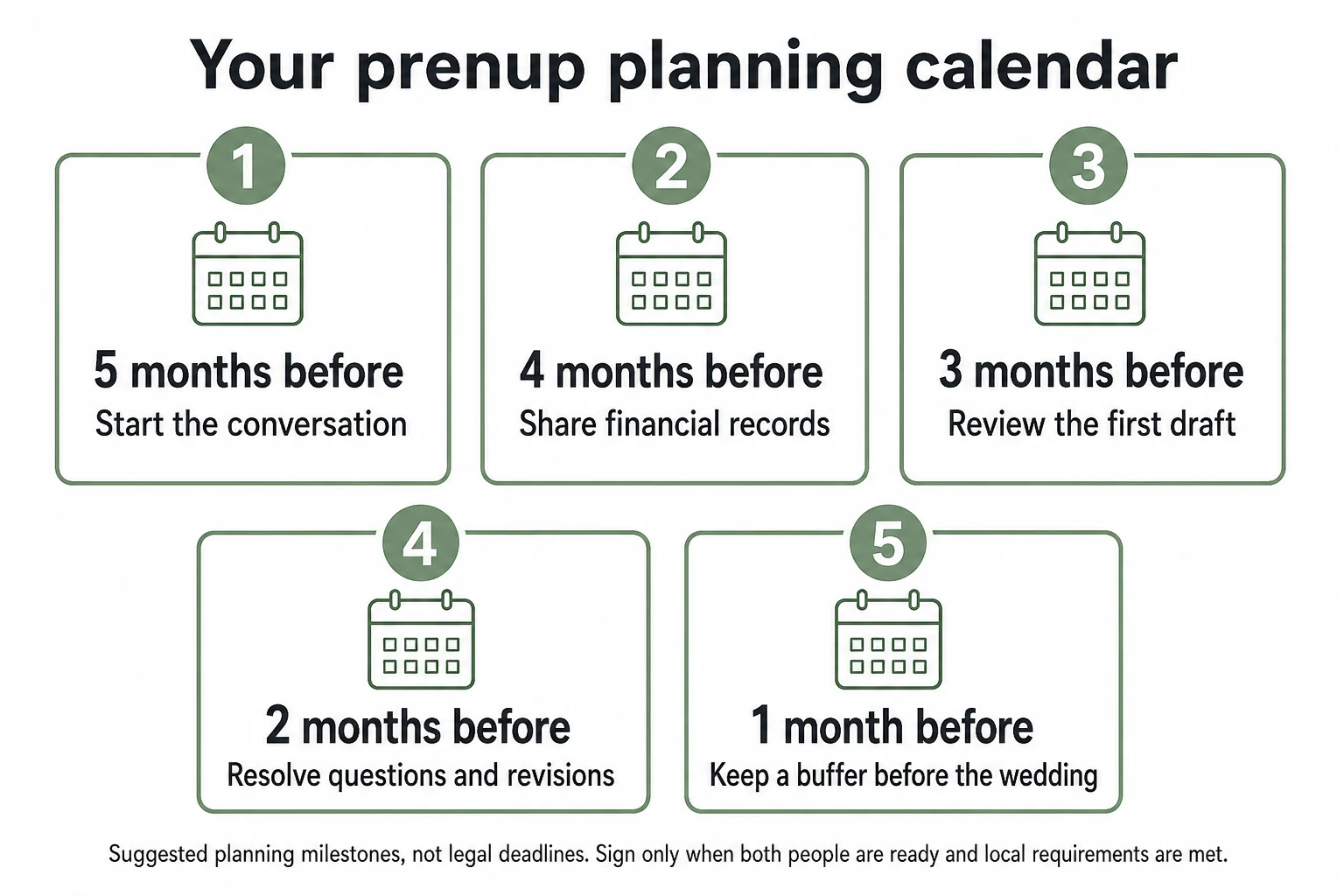
Five months before: start the conversation and book advice
Agree on why you are exploring a prenup and what each of you needs from the process. Put the follow-up conversations in your calendar and begin looking for family lawyers who can advise each of you independently.
Ask about availability, what their fee covers, and whether they will review an externally prepared draft. Include both partners' legal costs in the wedding budget, plus room for revisions or valuations if needed.
By the end of this month: both people have had a chance to raise concerns, you have identified the main topics, and you know how to arrange advice. Agreement on every term is not the goal yet.
Four months before: share your financial information
Each person gathers current account and investment statements, debt balances, income information, property records, and relevant business or pension documents. Flag family loans, personal guarantees, and anything whose value needs professional help.
Exchange the information with enough time for questions. A verbal estimate of “roughly what I own” may leave important gaps. Use our financial disclosure guide to build a more complete file.
By the end of this month: both people can see the financial picture, and missing documents have a clear next step. If a business valuation will take longer, adjust the remaining milestones now.
Three months before: prepare and review the first draft
Turn the topics you have discussed into a draft, using a lawyer or a preparation service followed by professional review. Give each person time to read the document and discuss it privately with their own adviser.
Ask practical questions: What happens if one person reduces paid work? How would mortgage contributions be treated? Does the wording match what we thought we agreed? Keep a list of questions and proposed changes.
By the end of this month: you have a working draft, each person has access to independent advice, and unresolved points are written down. A downloaded template is an intermediate step, not the finished task.
Two months before: resolve changes and work toward signing
Use this period for negotiations, revised wording, and any further advice. Check that both people and their advisers are working from the same version and that financial information is updated where needed.
Work toward signing once the issues are resolved, both people understand the final agreement, and local formalities are ready. Ask your advisers to confirm the appropriate witnessing, acknowledgment, or notarial steps.
By the end of this month: ideally, the reviewed agreement is signed and each person has a complete copy. If significant questions remain, give them time instead of treating the milestone as an ultimatum.
One month before: keep a buffer
Try to keep this month available for wedding logistics rather than first-time negotiations. Confirm that you can both access the signed agreement and supporting records. Ask your adviser about any material financial changes since signing.
This buffer creates flexibility for an unexpected delay. It does not make an agreement legally safe simply because you signed more than 30 days before the ceremony.
How long before the wedding must a prenup be finalized?
There is no single Canada-wide number of days that makes every prenup valid. The suggested two-month signing target above is an organizational choice. The quality of the process and the law that applies to you matter more than hitting that date.
For example, British Columbia's Family Law Act, section 93 allows courts to set aside property agreements on grounds including significant nondisclosure, improper advantage of vulnerability, or failure to understand the agreement. BC public legal guidance also identifies signing under pressure shortly before a wedding as a potential enforceability problem.
Quebec has a different process: a marriage contract must be signed before a notary. Book that appointment early. Requirements elsewhere also vary, so confirm the process for your province rather than borrowing another province's signing checklist.
Add finances to your wedding to-do checklist
Alongside vendors, outfits, and guest numbers, put these tasks in your shared planner:
- Wedding spending: agree on the total budget, who pays each deposit, and how remaining invoices will be funded.
- Family contributions: clarify whether money from parents is a gift or a loan, and to whom. Keep the relevant records.
- Life after the wedding: decide how you will handle bills, savings, existing debts, and shared accounts.
- Prenup preparation: assign dates for disclosure, drafting, independent advice, revisions, and signing.
- Legal costs: budget for both people's advice. Our guide to who pays for a prenup offers options to discuss.
- Related paperwork: arrange advice on wills, beneficiary designations, insurance, and powers of attorney where relevant.
- Document storage: make sure each person has access to the final agreement and the records used to prepare it.
A prenup does not complete all these tasks for you. For example, a wedding spending plan still needs actual payment arrangements, and estate documents need their own review.
What if the wedding is already close?
If you are three months out, begin now and ask your advisers whether the remaining work fits. You may already have documents and shared decisions in place; another couple may need considerably longer.
If you are only weeks away, explain the date and outstanding issues when contacting lawyers. Avoid demanding a signature because deposits are paid or relatives have booked flights. Our last-minute prenup guide covers that situation separately.
If a careful process cannot be completed before the ceremony, get advice about the consequences of marrying without the agreement and whether a later marriage contract is appropriate. A post-wedding agreement requires both people's agreement and may not produce the same position as signing beforehand. Never backdate it.
Put the first conversation on the calendar
Choose a quiet time this week, share one reason you want to discuss your finances, and invite your partner's priorities. You can leave the legal wording for a later step.
When you are ready to organize your answers, GoodTerms can help you prepare a prenup template to take for lawyer review. Keep time for independent advice and any changes before signing.
General Canadian legal information, not legal advice. The month-by-month schedule is an editorial planning suggestion, not a statutory deadline or legal assessment of your circumstances. Sources checked September 7, 2026.