A prenup can help Canadian couples decide how farmland, farm-company shares and future growth will be treated if their marriage ends. It cannot guarantee that a farm will never be sold, erase a lender's rights or replace a succession plan. The useful starting point is to identify what each person actually owns, then agree how both partners will build financial security.
If you are getting married while buying into, inheriting or working on a family farm, the questions below will help you prepare for a family lawyer with agricultural experience. A farm is rarely one asset, and “the farm stays in the family” leaves too much unanswered.
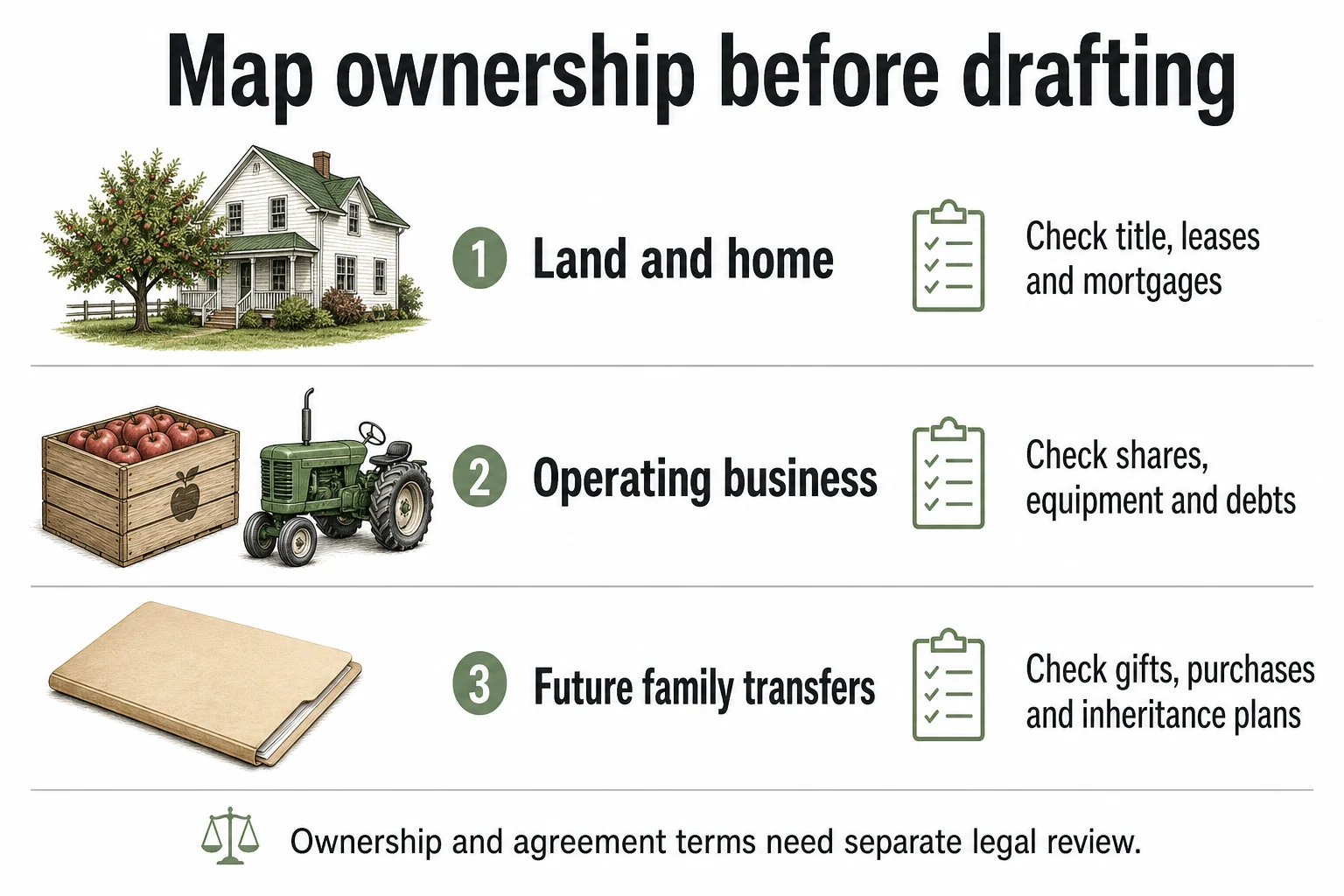
Start with three separate ownership questions
Your parents might own the land, a corporation might own the equipment, and you might own shares in that corporation. Living or working there does not make those interests interchangeable.
| What to map | Documents to gather | Question for your agreement |
|---|---|---|
| Land and farmhouse | Titles, leases, mortgages and purchase records | Which interests belong to either partner, and where will you live? |
| Operating business | Share register, partnership agreement, accounts and loan records | What is owned now, and what value or growth might be shared? |
| Future family transfers | Proposed gifts, purchase terms, wills and succession documents | What might transfer later, to whom, and on what conditions? |
Include livestock, inventory, production quota where applicable, equipment financing and shareholder loans. Mark estimated values as estimates. A tax return's book value is not automatically the value appropriate for a family-property agreement.
An expected inheritance should be described as an expectation, not property already owned. For the broader distinction between gifts, inheritances and purchases, see our prenup inheritance guide.
Five decisions worth making before the wedding
1. Separate existing interests from future growth
Decide whether the agreement should address the value brought into the relationship, later increases, future acquisitions, or some combination. Avoid a vague exclusion of “all farm assets” when ownership includes several people and companies.
Ask how the proposed terms would handle an orchard expansion, newly purchased acreage or proceeds from selling equipment. A replacement asset may need different documentation from the original one. Your lawyer should test the wording against the farm's actual structure.
2. Recognize both partners' contributions
One partner may own shares while the other handles bookkeeping, works unpaid during busy periods, contributes savings or pauses a career to care for children. Discuss those commitments before deciding what property will remain separate.
Possible subjects for negotiation include paid work, reimbursement of documented investments, retirement savings, a defined share of growth or a separate financial provision. These are discussion options, not ready-to-sign clauses. Check how they interact with employment arrangements, taxes and support rights.
Our guide to balanced prenup terms can help both partners prepare their priorities.
3. Give any payment promise a workable funding plan
If an agreement provides for a payment on separation, ask where the money would come from. A valuable farm can still have limited available cash.
Discuss valuation dates, the method for choosing a valuator, payment timing, interest, security and what happens if refinancing is unavailable. The receiving partner needs a realistic route to payment; the operating partner needs terms the business can carry. An instalment proposal deserves independent review rather than an assumption that waiting is fair.
Farm Credit Canada's farm prenup case study illustrates why ownership, contributions and settlement funding belong in the same conversation. It is a fictional example, not a standard formula or a promised court outcome.
4. Check the farmhouse separately
Do not assume that a residence loses family-home protections because it sits on agricultural land or because the operating business is incorporated. Ask who owns the residence, what legal interest either spouse has, and which provincial rules apply.
Housing arrangements also matter practically. If both partners depend on living at the farm, discuss how an unexpected separation would affect accommodation and ongoing work, subject to applicable legal rights.
5. Coordinate the other documents
A prenup between two people does not itself rewrite their parents' will, change corporate ownership or release a loan guarantee. Bring the proposed terms to the professionals handling the farm's shareholder agreement, partnership arrangements, leases, insurance and succession plan.
FCC's guidance on written farm agreements explains why transition planning often involves several agreements. Check for conflicts, such as a proposed settlement requiring a share transfer that the shareholder agreement restricts.
Provincial differences that change the conversation
These examples show why a Canadian farm prenup needs local review. They are not a complete survey of provincial property law.
Ontario: A marriage contract can address property division, but it cannot limit rights under Part II of the Family Law Act concerning the matrimonial home. Section 18(3) specifically addresses a residence on property used for another purpose: only the portion reasonably necessary for using and enjoying the residence is the matrimonial home. That boundary requires factual assessment, not a standard acreage allowance. Section 11 also limits property orders under sections 9 and 10 that would force the sale or seriously impair an operating farm unless no reasonable alternative exists. This is not a blanket exemption from financial claims. See the Ontario Family Law Act, sections 11, 18 and 52.
British Columbia: Property brought into the relationship and third-party gifts or inheritances may be excluded, while increases in excluded property's value generally form part of family property. Agreements can change property-division arrangements, but courts retain powers to set agreements aside and, in specified circumstances, divide excluded property. Identify the relevant relationship date rather than automatically using the wedding date. See the BC Family Law Act, sections 84–85 and 92–96.
Quebec: Marriage contracts must be signed before a notary. Choosing a matrimonial regime does not remove the separate family-patrimony framework. Farm-business interests and a family residence need careful classification under Quebec rules. The government's marriage-contract guidance explains the distinction. A downloaded draft cannot replace the required notarial process.
For farms elsewhere, ask a local family lawyer about property exemptions, homestead or family-home rights, signing requirements and the effect of any period of cohabitation. Do not transplant the Ontario examples into another province.
An example: joining the business without owning the land
Suppose Alex's parents own orchard land, and Alex owns 25% of the company operating on it. Sam plans to leave another job and manage farm sales after the wedding.
Their preparation should distinguish Alex's shares from the parents' land. It should also identify Sam's proposed pay, any money Sam invests, and what happens if Sam later reduces work for caregiving. A possible future land transfer should trigger a review, rather than being treated as already completed.
Alex and Sam can discuss keeping an existing share interest separate while making a deliberate provision for Sam's contributions. Their lawyers and accountant would need to assess the terms, values, tax implications and funding. The example illustrates questions to resolve; it does not calculate either person's legal entitlement.
What to prepare before paying for a draft
Make a shared folder containing the ownership records above, current debts, personal financial statements and the latest relevant business accounts. Each partner should disclose their own finances too.
Then write a one-page brief: what stays separate, what might be shared, how contributions will be recognized and which future changes require review. List unresolved questions openly. Our financial disclosure checklist can help organize the records.
Ask prospective lawyers whether their quote includes business-document review, valuation questions, negotiations and coordination with the farm's accountant. Give each partner time and separate legal advice. Family expectations about a prenup should not become a surprise ultimatum shortly before the wedding.
Common questions
Do we need a prenup if the farm is still in my parents' names?
Possibly. You may own shares, have loans or other interests, or expect a later transfer. Explain the actual arrangement to a lawyer instead of assuming that title alone settles every issue.
Will a prenup stop the bank pursuing a farm guarantee?
No. An agreement between partners does not release a borrower or guarantor from obligations to a lender. Ask the lender to confirm its release or refinancing requirements, and have your lawyer review them.
Can we make an agreement after marriage or while common-law?
An agreement may still be available. Married couples can explore a postnuptial agreement; unmarried couples can explore a cohabitation agreement. Existing rights, transfer dates and local requirements need review.
Can we start with GoodTerms?
GoodTerms offers a guided Canadian agreement draft with PDF and Word downloads. If you want to organize your general terms first, start a prenup draft. For a farm with corporate shares, succession transfers or complex valuations, ask an agricultural family-law specialist whether starting with a general draft is useful before purchasing. Budget separately for professional advice and any specialist drafting.
General legal information, checked September 5, 2026. This article is not legal advice or a farm-specific agreement. The photograph and checklist illustration were generated with AI.