
If your common-law partner has debt, you are not automatically added to the loan just because you live together. A creditor will usually look first to the people who signed, co-signed, or guaranteed the credit agreement.
That is only the first layer. Provincial family law may separately affect how debt is divided between partners if the relationship ends. A cohabitation agreement can set rules between you and your partner, but it generally cannot erase a bank or lender's contractual rights.
Quick answer: are you responsible for your common-law partner's debt?
The answer depends on whose name is on the credit and where you live.
| Situation | Who can the creditor usually pursue? | What can a cohabitation agreement change? |
|---|---|---|
| Credit card or loan only your partner signed | Usually your partner | How you reimburse each other or account for the debt between yourselves |
| Joint loan, mortgage, line of credit, or joint credit card | Either or both joint borrowers, depending on the contract | Who should ultimately pay between you, but not the lender's right to collect |
| You co-signed or guaranteed your partner's debt | You may be liable under the guarantee | Your partner's duty to reimburse you, subject to provincial law |
| Debt created during the relationship but kept in one name | The signer, as far as the creditor contract is concerned | Provincial family law and your agreement may affect allocation at separation |
The Financial Consumer Agency of Canada explains that a joint borrower signs the mortgage, loan, credit card, or line of credit agreement and becomes equally responsible for the unpaid balance. That responsibility comes from the credit contract, not from being common-law.
Three debt questions that couples often mix together
1. Who owes the lender?
This is mainly a contract question. Look at the loan, credit card, mortgage, line of credit, or guarantee. If both partners signed as borrowers, the lender may be able to pursue either of them for the balance. An agreement between partners does not normally rewrite that lender contract.
2. Who should pay between the partners?
This is where a cohabitation agreement can help. Partners can record that an old student loan remains one person's responsibility, that a joint car loan follows the person who keeps the car, or that a household line of credit will be split using an agreed formula.
3. How will debt be treated if the relationship ends?
This is a provincial family-law question. Ontario common-law partners do not enter the same automatic property equalization regime as married spouses. British Columbia can treat qualifying common-law spouses as equally responsible for family debt between themselves. Alberta applies family-property rules to adult interdependent partners, while Quebec has a different framework for de facto and parental unions.
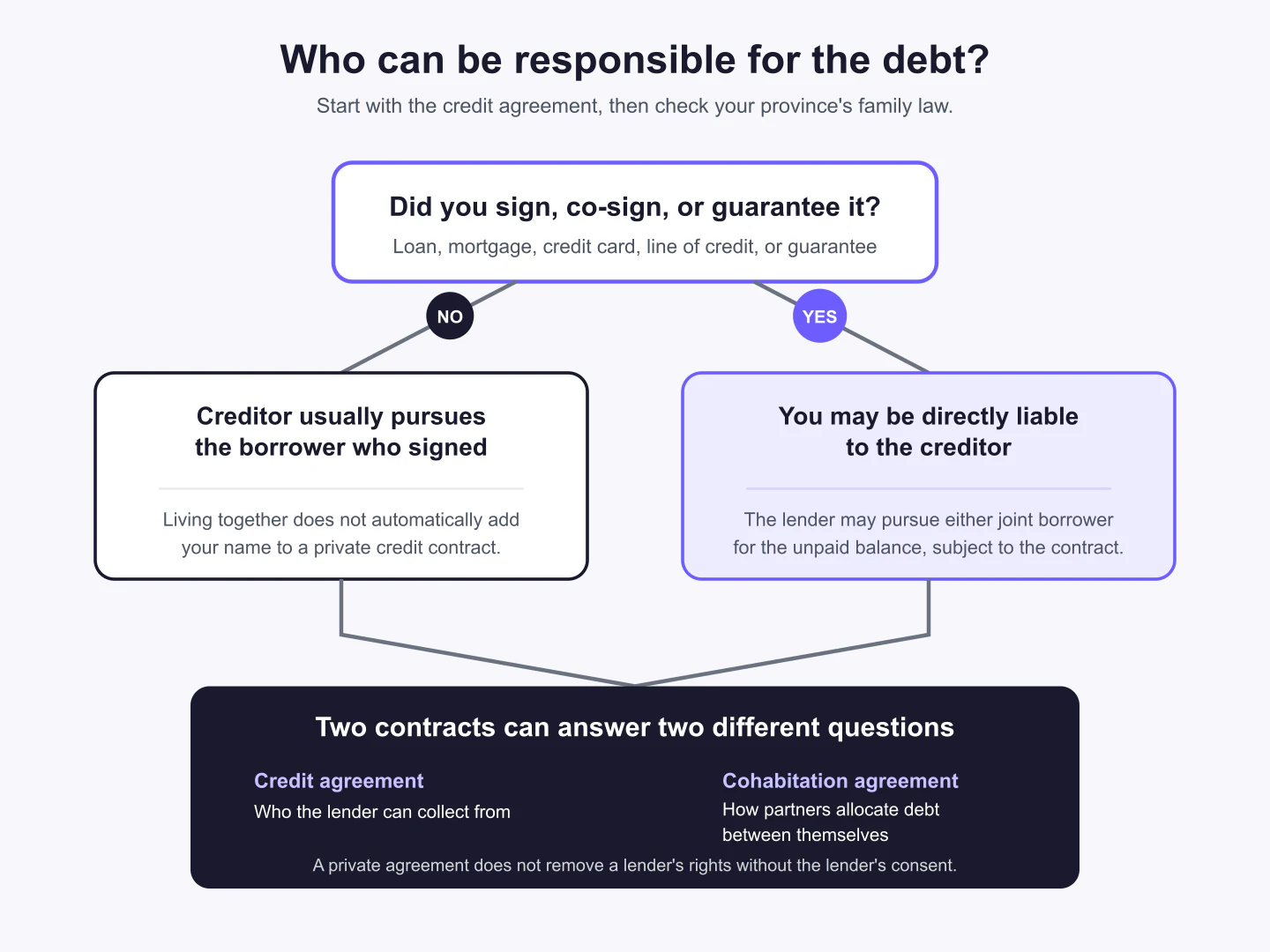
The safest approach is to answer all three questions. Looking only at whose name appears on a monthly statement can miss what happens between partners at separation. Looking only at a cohabitation agreement can miss what the lender is still entitled to do.
When can your partner's debt become your direct responsibility?
You signed as a joint borrower
Joint borrowers are responsible for the same credit account. This commonly happens with mortgages, vehicle loans, lines of credit, and some credit cards. The federal government's joint credit card guidance says co-borrowers are equally responsible for the balance.
If your partner later agrees to make every payment, that promise does not necessarily release you. The lender would usually need to approve a refinance, assumption, or other formal change.
You co-signed or guaranteed the debt
Co-signing is not a character reference. It creates legal responsibility. A lender may pursue a co-signer or guarantor when the primary borrower does not pay, according to the terms signed.
Before guaranteeing a partner's business loan, lease, or personal line of credit, ask for the full agreement, the maximum exposure, any collateral, and the conditions for release. A private promise that your partner will cover the debt may support a claim between you, but it does not prevent the creditor from enforcing the guarantee.
You are a joint cardholder, not just an additional user
Credit card labels matter. A co-borrower is responsible for the balance. An additional or supplementary cardholder may have permission to use the account without being a co-borrower. Confirm the account status with the issuer instead of relying on the card in your wallet.

You used jointly owned property as security
A debt can affect both partners when jointly owned property secures it. A mortgage or home equity line may put the home at risk even if the partners intended one person to make the payments. Title, the loan documents, and any guarantee need to be reviewed together.
Common-law debt rules in four provinces
“Common-law” does not create one Canada-wide property system. The federal definition used for tax or benefits does not decide every provincial family-property issue.
| Province | Starting point | Planning implication |
|---|---|---|
| Ontario | Each common-law partner is usually responsible for their own debt unless an agreement or joint credit says otherwise. Common-law partners do not automatically equalize property like married spouses. | Document separate and joint debt clearly. Ontario's Family Law Act allows a cohabitation agreement to address property and the settlement of the partners' affairs. |
| British Columbia | After two years in a marriage-like relationship, family debt can be shared between spouses at separation, even if only one spouse incurred it. Creditor rights remain separate. | An agreement can divide debt differently between partners, but it does not remove a creditor's rights. |
| Alberta | Adult interdependent partners fall within Alberta's family-property framework. Partners can opt out and make their own property-division agreement. | Confirm when the relationship of interdependence began, list debt from before and during the relationship, and use separate legal advice for an opt-out agreement. |
| Quebec | De facto spouses outside a parental union generally do not have a family patrimony together. A cohabitation agreement may list debts and specify how partners will repay them after separation. Parental-union rules may add another layer for some parents. | Identify whether you are in a standard de facto union or a parental union before choosing debt terms. |
Ontario's current public guidance confirms that common-law partners can use a cohabitation agreement to define property rights, and CLEO's common-law debt guide states that each partner is usually responsible for their own debts unless both signed or agreed otherwise.
British Columbia draws the creditor-versus-partner distinction especially clearly. Sections 81 and 82 of the BC Family Law Act address responsibility for family debt between spouses while preserving creditor rights. BC's public legal-information service also explains that a creditor can collect only from the signer, or from either partner if both signed.
Alberta's government explains that adult interdependent partners entered the family-property regime in 2020 and can opt out with their own agreement. Quebec's government says a cohabitation agreement can inventory personal debts and set repayment rules.
Other provinces have their own thresholds and family-property statutes. For example, qualifying partners in Manitoba and Saskatchewan should not assume Ontario's separate-property starting point applies to them. A Canada-wide common-law property overview can help you identify the questions to take to a local lawyer.
What a cohabitation agreement can do about debt
A useful debt section is more specific than “each person keeps their own debt.” It can:
- Attach a starting debt schedule. Record the lender, account type, approximate balance, borrower, guarantor, and whether any property secures the debt.
- Define separate debt. State how student loans, tax balances, personal cards, business loans, and pre-relationship obligations are treated between the partners.
- Define joint debt. Explain how mortgage, vehicle, renovation, or household borrowing will be allocated.
- Match assets and liabilities. If one person keeps a financed vehicle or another asset, state how the related loan and refinancing will be handled.
- Address guarantees. Require disclosure and written consent before either partner uses joint property or asks the other to guarantee new credit.
- Create reimbursement rules. Explain what happens if one partner pays more than their agreed share or a creditor collects from the other partner.
- Set review triggers. Revisit the agreement after a home purchase, major loan, business guarantee, move to another province, marriage, or material change in debt.
For a broader preparation list, use the Canadian cohabitation agreement checklist. If you already live together, you can still make an agreement, as explained in the after-moving-in guide.
What the agreement cannot do
A cohabitation agreement generally cannot:
- remove a borrower's or guarantor's name from a lender contract;
- stop a creditor from enforcing rights against someone who signed;
- transfer secured debt without the lender's consent;
- guarantee that a future court will uphold every term;
- replace a consumer proposal, bankruptcy process, or insolvency advice; or
- decide child support or parenting terms in advance.
If either partner is already missing payments, facing collections, or considering insolvency, family-law drafting is only part of the problem. Speak with a licensed insolvency trustee and a family lawyer before moving assets, refinancing, or signing new guarantees.
Four practical debt scenarios
One partner brings a student loan into the home
Only that partner signed the loan, so the creditor normally pursues them. The cohabitation agreement can identify the opening balance and say whether household contributions toward it create any reimbursement claim. Provincial separation rules still need to be checked.
Both partners finance a vehicle, but one keeps it after separation
Both remain exposed to the lender until the loan is paid, refinanced, or formally changed. The agreement can require the person keeping the vehicle to refinance by a deadline and indemnify the other partner, but the lender is not bound by that promise.
One partner opens a private credit card during the relationship
In Ontario, the creditor usually looks to the cardholder and common-law partners do not automatically equalize property. In BC, the cardholder may be the only person the creditor can sue, while the balance may still be treated as family debt between qualifying spouses. The purpose of the borrowing can matter, so province-specific advice is important.
One partner guarantees a business lease
The guarantee can create direct personal exposure even if the business belongs to the other partner. The agreement should record the guarantee, any security, reimbursement rules, and what happens if business assets are sold. High-risk guarantees deserve legal advice before signing, not only after a missed payment.
A seven-question debt conversation before you sign
Ask each other:
- What debt exists today, and whose name is on each account?
- Has either partner co-signed, guaranteed, or pledged property for someone else?
- Which debts will be paid from joint money?
- Can either partner open joint credit without written consent?
- If one partner keeps an asset, how will its loan be refinanced?
- What life changes should trigger a review?
- Which province's law applies now, and what happens if you move or marry?
Use statements and current credit reports instead of memory. Each person can obtain their own credit report and then disclose the relevant accounts. The goal is not to merge credit histories. It is to make informed decisions before signing joint obligations.
Frequently asked questions
Does becoming common-law combine our credit scores?
No. Credit files and scores remain individual. A joint account can appear on both files and missed payments can affect both borrowers.
Can a creditor take my property for my partner's debt?
Usually a creditor needs a legal right against you or the property, such as your signature, guarantee, joint ownership issue, or security interest. The answer can become complex when property is jointly owned or a province's family-property rules apply, so get advice before transferring or selling assets.
If our cohabitation agreement says my partner pays, am I safe?
Not necessarily. The agreement may create rights between you and your partner, but a lender that did not agree to the change may still pursue anyone who signed the credit contract.
Should we keep all debt separate?
That is a financial decision, not a universal legal rule. Separate accounts can make responsibility easier to trace, but couples may still choose joint borrowing for a home or vehicle. Understand the lender contract and document the plan before signing.
Do both partners need lawyers?
Separate legal advice helps each partner understand the provincial default, the agreement, and the rights being changed. It is especially important when debts are large, one partner is guaranteeing the other's obligations, or the terms are unequal. Read more about lawyer review for cohabitation agreements.
Is a cohabitation agreement worth it when debt is the main concern?
It can be. A clear agreement can preserve a record of starting debt, define responsibility between partners, and set a plan for future joint borrowing. Compare drafting and review options in the cohabitation agreement cost guide.
Turn the debt conversation into a written plan
GoodTerms' Canadian cohabitation flow helps couples turn decisions about separate debt, joint borrowing, property, and separation into a structured starting draft. The current price is $49 CAD for three generation credits. You can start a cohabitation agreement online and then arrange province-appropriate legal review.
Sources checked
- Financial Consumer Agency of Canada: rights of joint borrowers
- Financial Consumer Agency of Canada: joint credit cards
- Ontario: dividing property when a marriage or common-law relationship ends
- Ontario Family Law Act, sections 53 to 56
- British Columbia Family Law Act, sections 81, 82, and 92
- Family Law in BC: dealing with debts after separation
- Alberta: dividing property between unmarried partners
- Gouvernement du Quebec: cohabitation agreements
This article provides general legal information, not legal advice. Debt liability, property division, and domestic-contract rules vary by province and by the documents signed. Consult a lawyer in your province and a licensed insolvency trustee where appropriate. Sources and product pricing were reviewed on August 16, 2026.