
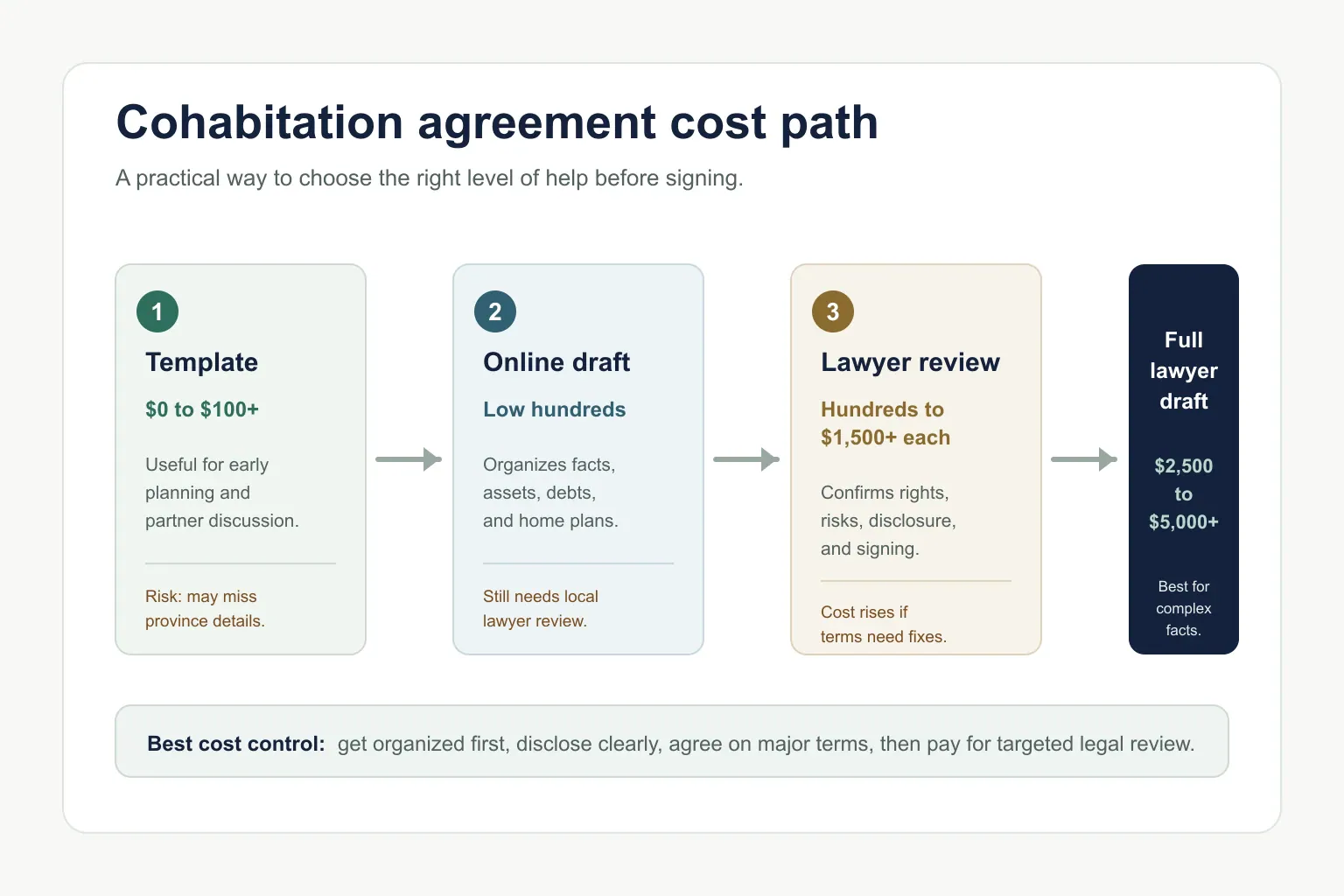
A cohabitation agreement in Canada has two main costs: preparing the draft and getting independent legal advice. A personalized GoodTerms draft costs $49 CAD, with lawyer review and revisions charged separately. Published lawyer-drafting examples checked for this guide include $3,100 plus HST at Nussbaum Law and $3,000 to $5,000 plus applicable taxes at RDM Lawyers.
The $49 price is for the working draft, not a completed lawyer-reviewed agreement. Each partner should budget for separate legal advice before signing. Ask each lawyer whether they will review an online draft and what their fee includes.
Cohabitation agreement cost in Canada: quick comparison
Prices checked September 4, 2026. These options cover different amounts of work, so compare the scope as well as the price.
| Option | Published price and scope |
|---|---|
| GoodTerms guided draft | $49 CAD, one-time. Personalized working template. Both partners' lawyer fees are extra. |
| Nussbaum Law, Ontario | $3,100 plus HST. Agreement preparation when the parties are generally aligned. The other partner's legal advice is extra. |
| RDM Lawyers | Most agreements: $3,000 to $5,000 plus applicable taxes. Lawyer-led preparation for one partner. The other partner's legal advice is extra. |
These are selected published examples, not a national average or a quote for your situation. RDM describes $3,000 as its typical minimum fee and initial retainer, not a cap on the final bill. The lawyer-led options include professional work that GoodTerms' platform fee does not.
For independent legal advice on an existing draft, get a quote for each partner. Confirm whether it includes rewriting, negotiation and signing. Free or generic templates vary by provider and still need personalization and separate legal review.
For a GoodTerms draft, plan the total as $49 CAD + each partner's legal fees + any additional professional costs and applicable taxes. GoodTerms is not a law firm and does not provide legal advice. Check current GoodTerms pricing and get written quotes from separate lawyers before choosing a route.

Why cohabitation agreements cost less, or more, than expected
A simple agreement costs less when both partners already agree on the big terms and the financial picture is easy to explain. For example:
- You rent together and do not own real estate.
- Each partner has separate bank accounts and manageable debt.
- There is no business, trust, pension complexity, or expected inheritance.
- You are not trying to waive or limit support in a risky way.
- You have both disclosed assets and debts clearly.
The cost rises when the lawyer has to untangle facts, negotiate terms, or manage risk. A cohabitation agreement is not just a form. It can affect what happens to property, debts, support, household contributions, and sometimes what happens if the couple later marries.
In Ontario, for example, cohabitation agreements are a type of domestic contract. They can address property and support, must be in writing, signed, and witnessed, and a court can set aside a domestic contract in situations such as significant non-disclosure or a party not understanding the consequences. That is why "quick and cheap" can become expensive if the agreement is careless.
What a lawyer is actually charging for
When you hire a family lawyer to draft or review a cohabitation agreement, you are paying for more than document typing. The work may include:
- an intake meeting to understand the relationship and goals
- reviewing assets, debts, income, pensions, businesses, and real estate
- identifying provincial rules that matter
- explaining rights each partner may be changing
- drafting custom clauses
- reviewing the other partner's requested changes
- advising on financial disclosure
- arranging signing requirements
- preparing an independent legal advice certificate or memo, where appropriate
The more a lawyer has to investigate, negotiate, or correct, the more the fee usually grows.
What the published lawyer fees include
Nussbaum Law's Ontario fee page lists $3,100 plus HST for a cohabitation or separation agreement when the parties are generally on the same page. Its stated exclusions include the other party's independent legal advice and third-party costs.
RDM Lawyers' cohabitation guide says most agreements cost $3,000 to $5,000 plus applicable taxes. The final fee depends on complexity, financial disclosure and revisions after the other partner's review.
Neither example should be treated as an all-in price for two independently advised partners. Ask what is included, what costs extra and whether the firm accepts an externally prepared draft.
Online cohabitation agreement cost: where it fits
Online tools are useful when you want to reduce the amount of blank-page drafting before legal review.
A guided tool can help you:
- identify what each partner owns and owes
- record who pays rent, mortgage, utilities, repairs, and household expenses
- clarify whether assets stay separate or become shared
- describe what happens to a shared home
- plan debt responsibility
- collect business, inheritance, investment, and family gift details
- prepare a lawyer-ready PDF or Word draft
GoodTerms' cohabitation agreement flow turns guided answers into a personalized working template. The $49 CAD package includes 3 agreement generations, PDF and editable Word downloads, and email support. There is no subscription. Lawyer review is separate.
It is not a replacement for legal advice. Think of it as a way to arrive at the lawyer's office organized instead of starting from scratch.
Do both partners need independent legal advice?
Separate legal advice is strongly recommended for cohabitation agreements in Canada, even when it is not always written as a strict requirement in every province.
The reason is practical. If the agreement is ever challenged, it helps to show that both partners:
- understood what they were signing
- had a chance to ask questions
- were not pressured
- disclosed important assets and debts
- knew which rights they might be changing
In Ontario, a court may set aside a domestic contract if a party failed to disclose significant assets, debts, or liabilities, if a party did not understand the nature or consequences of the agreement, or under general contract law. Independent legal advice helps reduce those risks.
In British Columbia, the Family Law Act treats many common-law partners as spouses after two years in a marriage-like relationship. It also lets spouses make written agreements about property and debt, while giving courts power to set aside agreements in certain circumstances, including significant non-disclosure, improper advantage, lack of understanding, or significant unfairness.
In Alberta, adult interdependent partners can be covered by property division rules, and Alberta government guidance says adult interdependent partners can opt out and draft their own agreement if they want different property division rules.
In Quebec, the language and rules are different. Quebec describes these as cohabitation agreements for de facto spouses. Quebec guidance says the agreement can set rules for property, responsibilities, debts, and separation, but it does not replace a will or protection mandate.
Province matters
Canada does not have one single cohabitation agreement rule. The province can affect what your agreement needs to address and what legal review should focus on.
Ontario
Ontario's Family Law Act recognizes cohabitation agreements. A couple who is cohabiting or plans to cohabit can agree on rights and obligations during cohabitation, on separation, or on death, including property and support. If the couple later marries, the cohabitation agreement is generally deemed to be a marriage contract unless the agreement says otherwise.
For Ontario couples, a lawyer should review:
- whether the agreement should continue if you later marry
- how property division is handled
- whether support clauses are realistic
- whether signing and witnessing are done properly
- whether financial disclosure is complete enough
British Columbia
BC can be especially important for unmarried couples because the Family Law Act includes people who have lived together in a marriage-like relationship for at least two years in its definition of spouse for many family law purposes.
BC couples should review:
- whether they are already spouses under BC family law
- what is family property, family debt, and excluded property
- whether the agreement is witnessed
- how the agreement could be challenged later
Alberta
Alberta uses the concept of adult interdependent partners. Government guidance explains that these relationships can include two people in a marriage-like relationship, and that property division changes apply to adult interdependent partners.
Alberta couples should review:
- whether they are adult interdependent partners
- whether they want to opt out of default property division rules
- how the agreement handles property bought before and during the relationship
- whether each partner needs separate advice before signing
Quebec
Quebec uses the concept of de facto spouses and has a distinct civil-law framework. Quebec guidance says de facto spouses can set out rules in a cohabitation agreement and can sign in front of two witnesses or have it prepared by a notary or lawyer.
Quebec couples should review:
- whether they are in a de facto union or parental union
- how property and debts should be handled
- whether support or compensatory payments are permitted in their situation
- why the agreement does not replace a will
What drives the price up?
Most cost increases come from complexity, not the label on the document.
1. Real estate
A shared home, condo, cottage, mortgage, down payment gift, or renovation contribution usually requires careful drafting. The agreement should say who owns what, who pays what, what happens if one partner contributes more, and what happens if the relationship ends.
2. Unequal income or career sacrifice
If one partner earns much more, pays more of the household expenses, or plans to reduce work for caregiving, support clauses need more care.
3. Business ownership
Businesses raise questions about current value, future growth, income, retained earnings, shareholder agreements, and what information can be disclosed.
4. Debt
Student loans, tax debt, lines of credit, business debt, and mortgage obligations should be disclosed and allocated clearly.
5. Children or blended families
A cohabitation agreement cannot override child support law or predetermine parenting outcomes in a way a court will ignore. But children still affect household expenses, estate planning, property expectations, and support risk.
6. Disagreement
The biggest cost driver is often negotiation. If both partners agree on the broad plan, drafting and review are easier. If every clause becomes a debate, legal time rises quickly.
How to reduce the cost without weakening the agreement
You can often reduce legal fees by doing the organization work before a lawyer gets involved.
Before legal review, prepare:
- full legal names and province of residence
- date you moved in together or plan to move in
- list of assets each partner owns
- list of debts and liabilities
- real estate details, including title, mortgage, down payment, and renovation contributions
- business ownership details
- income ranges and major benefits
- household expense plan
- what should happen if you separate
- what should happen if you later marry
- estate planning notes, especially if there is a home or children
This is where an online draft can help. It turns vague intentions into a structured document a lawyer can review, revise, and explain.
Template vs online tool vs lawyer: which should you choose?
Choose a basic template only if you are still brainstorming and do not plan to sign it without review.
Choose an online guided draft if you want a more organized starting point and you are comfortable taking the final document to lawyers before signing.
Choose a lawyer-drafted agreement from the beginning if:
- one partner owns a home
- you are buying property together
- either partner owns a business
- there are children from another relationship
- one partner is giving up income or career opportunities
- you want to waive or limit support
- you are in Alberta, BC, Quebec, or another province where the legal context needs careful explanation
- your partner is uncomfortable or feels pressured
There is no prize for the cheapest agreement if the result is unclear. The goal is a document that both partners understand and that a lawyer can help you finalize properly.
Example budgets
Renting together, simple finances
With GoodTerms, start with the $49 CAD platform fee, then add a written legal-review quote for each partner. Confirm whether those quotes include revisions, signing, tax and disbursements. The total will depend on the advice and work each partner needs.
Buying a home together
Expect more legal involvement. A lawyer may need to address down payments, mortgage responsibility, title, repairs, sale rights, buyout mechanics, and what happens if one person wants to keep the home.
One partner owns a home already
Legal review is important. The agreement should address whether the non-owner contributes to the mortgage, renovations, or utilities, and whether those payments create any claim.
Business owner or high net worth partner
Budget for custom drafting. The agreement may need valuation assumptions, disclosure schedules, confidentiality provisions, and coordination with corporate or estate documents.
Is a cohabitation agreement worth the cost?
For many couples, yes. The value is not just legal protection. It is the clarity you get before moving in together, buying property, merging expenses, or making career decisions.
Canada has a large and growing common-law population. Statistics Canada reported that 23% of Canadian couples were living common law in 2021, and that common-law couples grew much faster than married couples from 1981 to 2021. More couples are living together without marriage, but the legal rules still vary sharply by province.
A cohabitation agreement helps couples replace assumptions with written decisions.
How GoodTerms can help
GoodTerms' $49 CAD package helps Canadian couples prepare a personalized cohabitation agreement template for separate lawyer review. See what the price includes before starting.
It can help reduce the time spent organizing:
- property and debt information
- shared home plans
- household contributions
- support intentions
- business, inheritance, and investment details
- what happens if you later marry
Start with GoodTerms' Canadian cohabitation agreement template, then have each partner get local legal advice before signing.
You can also read:
- Cohabitation Agreement in Canada: What It Covers and How It Works
- Prenup vs Cohabitation Agreement in Canada
- Prenup for Common-Law Partners in Canada
- How Much Does a Prenup Cost in Canada?
FAQ
How much does a cohabitation agreement cost in Canada?
A GoodTerms working draft costs $49 CAD, with each partner's lawyer fees charged separately. Published lawyer-drafting examples checked September 4, 2026 include Nussbaum Law at $3,100 plus HST and RDM Lawyers at $3,000 to $5,000 plus applicable taxes for most agreements. These are different service scopes, not all-in quotes for both partners.
Does the $49 GoodTerms price include lawyer review?
No. It covers the guided working draft, 3 agreement generations, PDF and Word downloads, and email support. Independent legal advice, lawyer revisions and any other professional fees are separate. Each partner should obtain advice from their own lawyer before signing.
Do I need a lawyer for a cohabitation agreement?
You should get legal advice before signing. Even if you use an online draft, each partner should understand the rights they may be changing and whether the agreement fits local law.
Can I write my own cohabitation agreement?
You can prepare your own draft, but signing a DIY agreement without legal review is risky. The agreement may miss provincial requirements, disclosure issues, support limits, or signing rules.
Is an online cohabitation agreement legally binding?
An online draft is a starting point. Whether a final agreement is enforceable depends on the province, content, disclosure, timing, signing, fairness, and whether each partner understood the consequences.
What is the cheapest way to get a cohabitation agreement?
An online working draft can lower the initial drafting expense, but the total depends on the legal work needed. Compare the platform fee and both lawyers' written quotes, including revisions and signing. A free form or a $49 draft is not the full cost of independent legal advice.
Is a cohabitation agreement the same as a prenup?
No. A cohabitation agreement is for unmarried partners who live together or plan to live together. A prenup, often called a marriage contract in Canada, is for couples who intend to marry. Some agreements can continue after marriage, but that should be handled carefully.
Sources and further reading
GoodTerms, Nussbaum Law and RDM Lawyers pricing was checked September 4, 2026. Fees can change; confirm current scope and pricing directly. This pricing check is not a legal review of the article.
- GoodTerms pricing and package inclusions
- Statistics Canada, common-law couples in Canada
- Ontario Family Law Act, domestic contracts
- BC Family Law Act
- Alberta, dividing property between unmarried partners
- Quebec, cohabitation agreement
- RDM Lawyers, cohabitation agreement costs and timeline
- Nussbaum Law, Ontario cohabitation agreement flat fee