
Quick answer: A postnup can help protect an inheritance in Canada by recording what was received, defining whether it stays separate, setting rules for growth and documenting what happens if inherited money is used for a shared goal. It is not a reset button. Provincial law, the path of the money and the fairness of the signing process still matter.
The most important decision may happen before signing: do you keep the inheritance separate, invest it through a traceable account, or put it into the family home? Those routes can produce different results.
This article is general legal information, not legal advice. Property rules differ by province, and each spouse should obtain advice about their own rights before signing or moving inherited funds.
Can a postnup protect inheritance? Five quick answers
| Question | Short answer |
|---|---|
| Can married spouses make an inheritance agreement after the wedding? | Often yes. The document may be called a postnuptial agreement, marriage contract or family property agreement, depending on the province. |
| Is an inheritance automatically shared in Canada? | Not always. Several provinces distinguish inheritances from other property, but exceptions, growth, tracing and family-home rules can change the result. |
| Can a postnup cover money that has already arrived? | Often, but the agreement should identify the asset and its current location. It may not recreate an exclusion that has already been lost. |
| Can the agreement bind a bank or change title by itself? | No. A private agreement between spouses does not automatically change a lender's rights, land title, tax treatment or an estate plan. |
| Does one spouse have to sign because the other inherited money? | No. A postnup requires genuine agreement. Pressure and incomplete disclosure can make the contract vulnerable. |
If you need the wider explanation first, read Can You Get a Prenup After Marriage in Canada?. The focus here is narrower: an inheritance received or expected during an existing marriage.
Start with the money trail, not the contract
The original estate payment may be easy to identify. Years later, the same value could be spread across an investment account, mortgage reduction, renovations and a joint account.
Before transferring anything, collect:
- the will, estate statement or executor letter;
- the deposit record and opening account balance;
- records for later transfers, purchases or sales; and
- appraisals, mortgage statements or investment records tied to the intended use.
This is tracing: proving the path from the inheritance to the property that exists later. A postnup can make the intended treatment clear, but the records establish what actually happened. Our financial disclosure guide explains how to build a complete working file.
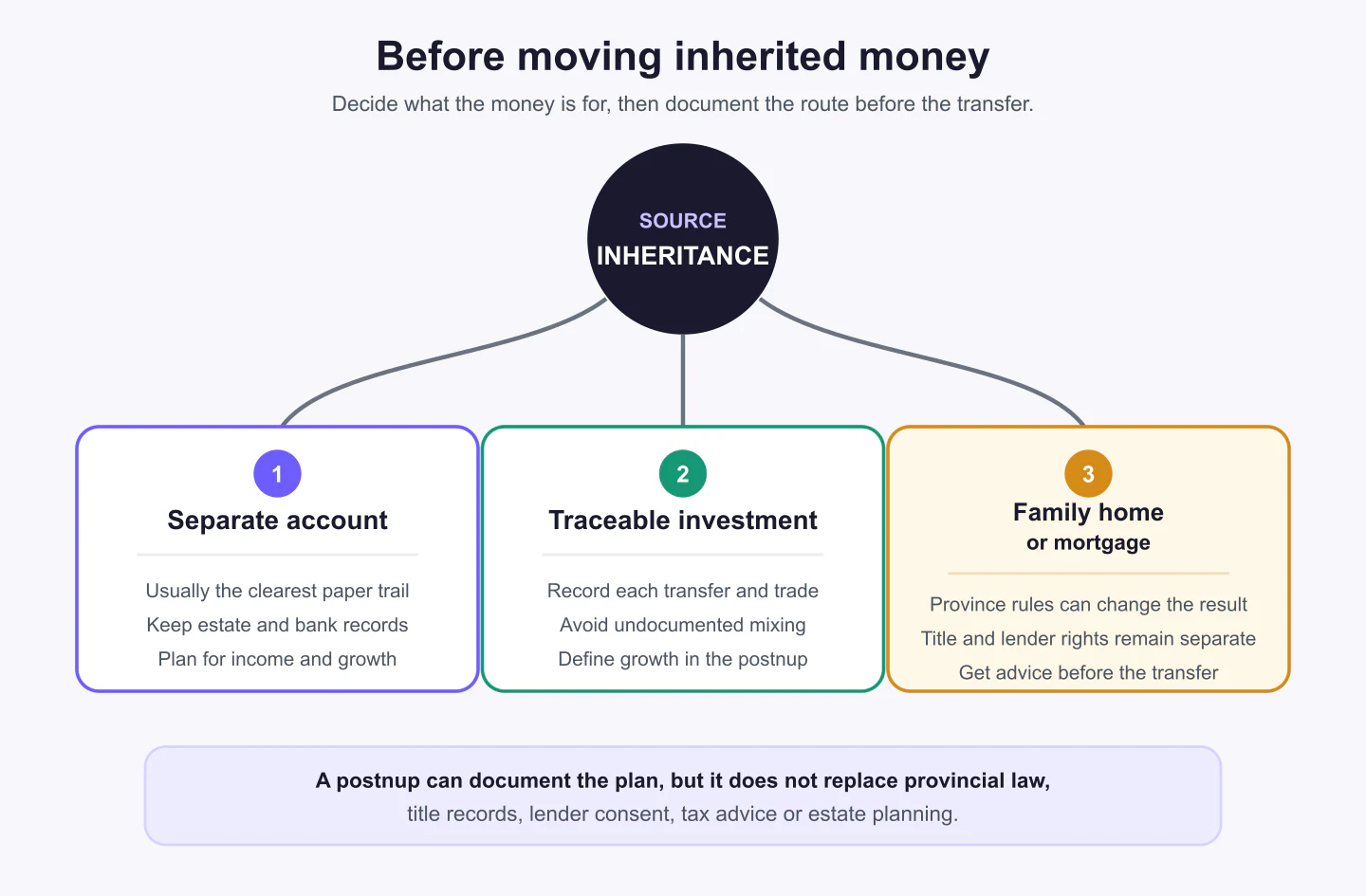
The planning map is intentionally simple. The law is not. Income earned on inherited property, growth in value, joint ownership and transfers between spouses are treated differently across Canada.
What an inheritance postnup can usefully cover
A useful postnup does more than say, “my inheritance stays mine.” It translates the plan into terms that can be tested with real accounts.
1. The exact property and starting value
List the estate, date received, amount or asset, account, current value and any liabilities. If the inheritance includes a cottage, private-company shares, foreign property or a trust interest, identify what must be valued and whether specialist advice is needed.
A future gift belongs to the donor or estate until transferred. The spouses can plan its treatment, but their postnup cannot force a third party to make a gift.
2. Separate, shared and mixed property
Define which inherited property remains separate and what conduct would make it shared under the agreement. Address deposits to a joint account, adding a spouse to title, exchanging one asset for another and using inherited funds for joint expenses.
Do not rely on a vague ban against “commingling.” Explain what happens if mixing occurs: a fixed credit, a percentage, the traceable amount, or no special credit after a defined transfer.
3. Income, growth and replacement property
The inheritance, its income and later appreciation may not receive identical treatment. A postnup can address interest, dividends, capital gains, reinvested proceeds and replacement property.
Use numbers to test the clause. A sentence that seems clear with a $100,000 cash deposit may be unclear after the account doubles, pays tax and funds a different asset.
4. The family home and mortgage
Record whether inherited funds used for a down payment, mortgage prepayment or renovation are intended as a gift to the marriage, a repayable contribution, a separate-property credit or part of a formula. Then test what the formula does if the home rises or falls in value, is refinanced, is sold, or one spouse buys out the other.
5. Death and estate coordination
A property agreement and a will answer different questions. Review wills, beneficiary designations, insurance and any promise that a surviving spouse may live in or inherit the home.
6. A balanced result and review triggers
The agreement can also address the non-inheriting spouse's mortgage payments, caregiving, renovations, retirement savings and housing security. Add review triggers for a new home, major gift, child, disability, retirement or interprovincial move.
The family home is the decision point
Using inherited money to reduce a mortgage can make the legal trail and the couple's intentions harder to separate.
Consider four different questions:
- Who is on title? Title records legal ownership. A postnup does not update land registration by itself.
- Who owes the lender? The mortgage contract determines who the bank can pursue. The bank is not bound by a private repayment promise between spouses unless it agrees.
- How will property be divided between spouses? Provincial family law and a valid agreement can affect this result.
- Where should the inheritance appear in the calculation? The agreement might use a fixed credit, percentage, tracing rule or another formula, subject to provincial limits.

Do this analysis before a mortgage or renovation transfer. If the money has moved, preserve the records and ask what can still be documented. A new clause may not turn a completed gift into separate property.
For a deeper house-focused discussion, see Can a Prenup Protect a House in Canada?.
Province rules that can change the plan
Canada does not have one national postnup statute. These examples show why a generic clause is not enough.
Ontario
Ontario's Family Law Act excludes certain property, other than a matrimonial home, acquired by gift or inheritance from a third person after marriage. It also refers to traceable replacement property. Ontario's property-division overview warns that an inherited family home does not receive the same exclusion.
Married spouses may make a written, signed and witnessed marriage contract about property. It cannot limit the special Part II rights concerning a matrimonial home, and a court may set it aside for significant nondisclosure, lack of understanding or ordinary contract-law reasons. Ask an Ontario lawyer to separate equalization planning from possession, consent and title.
British Columbia
Section 85 of British Columbia's Family Law Act lists inheritances and property derived from them as excluded property. The increase in value of excluded property is generally family property under section 84. The person claiming an exclusion must still be able to prove it.
Sections 92 and 93 allow written, witnessed agreements that include or exclude property and divide it unequally. A court may intervene for significant nondisclosure, improper advantage of vulnerability, lack of understanding or other contract reasons. BC also has a separate significant-unfairness analysis.
Alberta
Alberta's Family Property Act exempts the applicable-date market value of inherited property under section 7, while increases and replacement property can require a different analysis. Sections 37 and 38 let spouses address property by agreement, but the formal acknowledgement process is specific.
Each spouse must acknowledge the nature and effect of the agreement, possible future claims and voluntary signing, apart from the other spouse and before a different lawyer. A generic online signature is not a substitute for those lawyer acknowledgements.
Quebec
Quebec's Civil Code uses family patrimony and matrimonial regimes rather than the same model as the common-law provinces. Articles 415 to 418 contain specific rules for inherited or gifted property and contributions to family-patrimony property. The calculation can depend on the source, use and proportional increase in value.
Spouses may modify their matrimonial regime or marriage-contract terms during marriage, but articles 438 and 440 require a marriage contract made by notarial act en minute. Start with a Quebec notary before moving inherited funds into a family residence or changing the matrimonial plan.
Other provinces and territories have their own statutes, formalities and court powers. Confirm the province that governs the agreement, especially after a move.
Worked example: a $250,000 inheritance
Suppose Maya receives $250,000 during marriage. She and Jordan compare three routes.
Route A: keep it separate. Maya uses a new account in her name, retains the estate documents and avoids joint spending. The postnup defines the funds, income and growth. The province's rules still govern.
Route B: pay $150,000 onto the mortgage and spend $50,000 on renovations. The couple tests a fixed credit, percentage of net equity and other formulas against a sale, loss, refinance and buyout, then checks family-home limits.
Route C: invest it jointly. The couple records their choice and whether any original contribution remains separate, then aligns the account registration and estate plan.
There is no universal best route. The useful question is whether the legal documents, accounts and couple's expectations all tell the same story.
A seven-step process before signing
- Pause major transfers. Keep the inheritance identifiable while comparing the options.
- Collect source records. Gather the estate, bank, investment, title and mortgage documents.
- Define the goal together. Separate protection, a family investment, housing security and estate planning can require different terms.
- Exchange complete disclosure. Both spouses should disclose their assets, debts, income and significant obligations, not only the inheritance.
- Prepare a province-specific draft. Include schedules, formulas, review events and implementation steps.
- Use separate legal advice. Each spouse needs a private opportunity to understand the rights affected and request changes.
- Sign correctly and implement it. Complete the required witnessing or notarial process, then update accounts, title, wills, insurance or other records the plan requires.
If budget is part of the decision, the 2026 postnup cost guide separates the drafting price from legal review, valuations and other professional work.
When to start with a lawyer or notary
Skip a self-directed first draft and obtain professional help at the outset if:
- either spouse has decided to separate;
- the inheritance has already been put into a family home or complex joint assets;
- a trust, private business, farm, cottage, foreign asset or large tax issue is involved;
- the donor or estate imposed conditions;
- one spouse cannot access records or is being pressured to sign;
- title, creditor, bankruptcy or urgent preservation issues exist; or
- a Quebec matrimonial regime or Alberta acknowledgement is involved.
An online draft can organize a cooperative discussion. It cannot investigate hidden property, give tax advice or replace province-required professional work.
Frequently asked questions
Can we sign a postnup after the inheritance was received?
Often yes. Identify its source, current location, transfers and present value. If it has been mixed or spent, ask what can still be traced and legally addressed.
Does keeping an inheritance in a separate account guarantee protection?
No single step is a guarantee. A separate account can make the evidence clearer, but income, growth, withdrawals, local law and later conduct still matter.
Can a postnup recover inherited money already used on the home?
Do not assume so. The agreement may be able to record a credit or formula, but enforceability depends on provincial law, the facts and a fair process. It cannot rewrite completed lender or title transactions by itself.
Does the non-inheriting spouse have to agree?
Yes. A postnup is a two-party contract. One spouse cannot impose it, and a signing process built on pressure may weaken the agreement.
Does the person leaving the inheritance need to sign the postnup?
Usually the postnup is between the spouses. A donor, estate or trust may have separate documents or conditions that the postnup cannot change. Coordinate the plans where necessary.
How much does a postnup cost in Canada?
GoodTerms' current guided postnup draft is $49 CAD and includes three generation credits. Separate lawyer or notary review, valuations, tax advice and registrations are additional. Complex inheritance and home clauses may cost more to review than a straightforward cash-account plan.
Build the plan before moving the money
A postnup can turn an inheritance conversation into specific rules, but timing matters. Preserve the source records, decide what the money is for, test the home and growth formulas, and use a province-correct signing process.
For a cooperative Canadian starting point, create a personalized postnuptial agreement draft with GoodTerms for $49 CAD. Take the draft, disclosure schedules and source records to separate qualified professionals before signing.
If you are not married yet, use the earlier-stage inheritance prenup guide instead.
Prenuply AI Inc. is not a law firm and does not provide legal services or legal advice. This article provides general legal information for Canada and does not create a lawyer-client relationship. Family and property law varies by province and personal circumstances. The legislation and GoodTerms price were checked on August 17, 2026.