
Quick answer: A postnup after infidelity can help married spouses in Canada set clear financial rules while they decide whether to rebuild their relationship. It can address property, debts, a home, spousal support, disclosure, and related estate planning. It should not be treated as a guaranteed way to punish cheating. Canada uses no-fault principles for many financial issues, provincial laws differ, and an agreement made under pressure can be vulnerable later.
The strongest postnup usually answers a practical question: if we continue the marriage, what financial clarity do both of us need? It does not try to decide who is the better spouse.
This article provides general legal information, not legal advice. Each spouse should get advice about the law in their province and their own circumstances before signing.
Postnup after infidelity: five quick answers
| Question | Short answer |
|---|---|
| Can married spouses sign a postnup after an affair? | Often yes, if both agree and the provincial requirements are met. |
| Does cheating automatically change property division or support? | Generally no. The federal Divorce Act tells courts not to consider marital misconduct when making a spousal support order. |
| Can a postnup reorganize property, debts, or support? | Often yes, subject to provincial limits and a fair process. |
| Is an automatic financial penalty for future cheating reliable? | Do not assume so. Ontario expressly makes one type of chastity-based separation condition unenforceable, and penalty clauses can raise broader contract and public-policy concerns. |
| What if one spouse has already decided to separate? | Speak with a family lawyer about a separation agreement rather than using a reconciliation-focused postnup workflow. |
Canadian family law does not use one national postnup statute. The document may be called a marriage contract, family property agreement, or agreement between spouses depending on the province. If you need the broader starting point, read Can You Get a Prenup After Marriage in Canada?.
What a postnup can usefully cover after infidelity
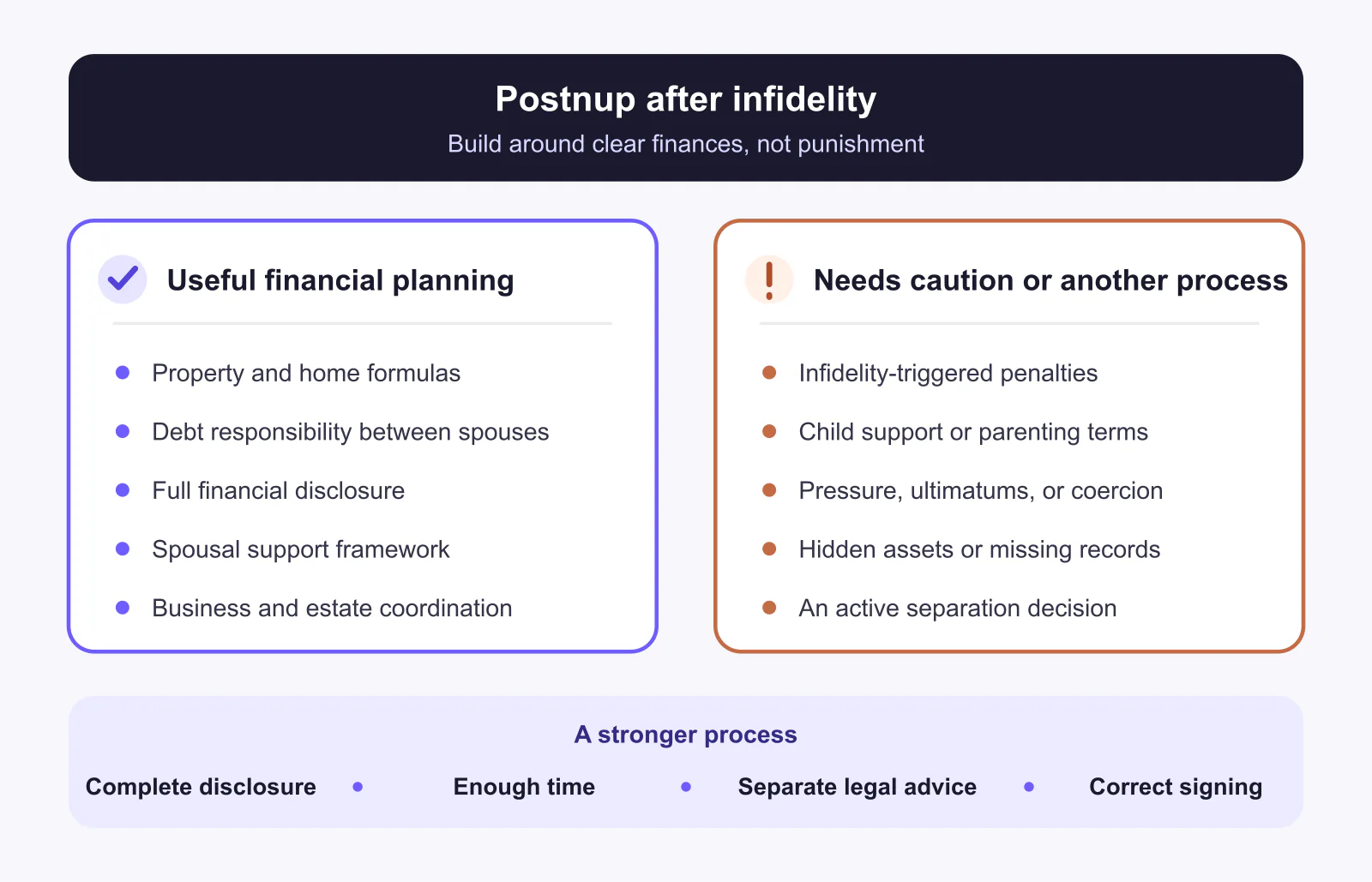
Infidelity can uncover financial questions that existed before the affair: one spouse may not know what accounts exist, who owes which debts, how the home is funded, or what would happen if reconciliation fails. A postnup can turn those questions into specific financial terms.
1. A dated picture of assets and debts
Each spouse can list real estate, bank and investment accounts, pensions, business interests, credit cards, loans, guarantees, tax obligations, and valuable personal property. Supporting records matter more than a sentence saying that disclosure occurred.
If an affair involved unusual transfers, gifts, travel spending, new debt, or an undisclosed account, preserve copies of records you may lawfully access and discuss them with your own lawyer. Do not hide, destroy, or move assets to gain leverage.
Our financial disclosure guide explains what a complete working file can include.

2. Clear property rules from a known date
A postnup can define which property remains separate, which property is shared, how future growth will be treated, and what valuation date or formula applies. Those choices should be tested with actual numbers, especially when one spouse is giving up rights that already exist.
A reliable formula is usually more useful than a vague promise. For example, a home clause might record its current value and mortgage, then explain how later principal payments, renovations, appreciation, and a possible buyout will be handled.
3. Debt responsibility between the spouses
The agreement can allocate responsibility for existing and future debts as between the spouses. It can also require notice before either spouse takes on a major guarantee or uses a joint credit facility.
That private allocation does not automatically change a bank's or other creditor's rights. A lender that did not sign the postnup may still enforce the loan documents it holds. See our guide to prenups and significant debt for the difference between an agreement between spouses and creditor protection.
4. A spousal support framework
Spouses may be able to agree on support, a waiver, a formula, a review trigger, or a time-limited arrangement. The enforceability of support terms depends on the governing law and the facts when the agreement is made and later relied on.
The Divorce Act says marital misconduct is not a factor when a court makes a spousal support order. The Department of Justice explains the same no-fault principle in plain language. That is one reason a needs- and finances-based framework is usually safer than a clause framed as punishment for an affair.
Read more about spousal support in prenups, postnups, and cohabitation agreements.
5. Coordination with a home, business, and estate plan
A postnup may need to work alongside title records, shareholder agreements, wills, beneficiary designations, insurance, and tax advice. It does not change all of those documents by itself.
If the agreement promises a transfer, buyout, insurance policy, or estate benefit, list the implementation step, who must complete it, and by when. Otherwise, the postnup and the real-world records can point in different directions.
Why an infidelity penalty clause is risky
An infidelity clause usually tries to change a financial result if a spouse later has an affair. It may promise a lump-sum payment, a larger property share, or loss of support. The emotional appeal is easy to understand, but enforceability is not automatic.
Three problems appear quickly:
- No-fault principles: Canadian support law focuses on financial circumstances and the consequences of the relationship, not moral blame.
- Uncertain definitions: “Infidelity” could mean sexual contact, an emotional relationship, dating-app activity, or something else. Evidence and privacy disputes can overwhelm the financial purpose of the agreement.
- Penalty and fairness concerns: A term designed mainly to punish, especially one with an extreme result, can face contract-law and provincial family-law challenges.
Ontario is especially direct. Section 56(2) of its Family Law Act says a separation term that makes a right depend on remaining chaste is unenforceable. The same Act allows a court to set aside a domestic contract for significant nondisclosure, lack of understanding, or other contract-law reasons.
That does not mean infidelity is irrelevant to every fact. If secret spending created debt or reduced family property, the financial transactions may matter. The point is to draft around the financial facts and provincial law, not assume that a morality clause will deliver a guaranteed award.
Does the affair itself invalidate a postnup?
Not automatically. In the Ontario decision D'Andrade v. Schrage, 2011 ONSC 1174, the court refused to set aside a marriage contract merely because a spouse had been having an affair and considering separation. The court distinguished financial obligations from personal obligations such as fidelity or staying in the marriage.
That case is not a promise that every agreement signed during a marital crisis will survive. Courts can still examine disclosure, understanding, vulnerability, pressure, capacity, drafting errors, and the result produced by the agreement. The negotiation record matters.
Province-specific process points
Ontario
Married spouses may enter a marriage contract dealing with property, support, and other financial matters. It must be in writing, signed, and witnessed. A court may set it aside for significant nondisclosure, lack of understanding, or ordinary contract-law reasons. Ontario also has special rules for the matrimonial home and the chastity provision noted above.
British Columbia
Sections 92 and 93 of BC's Family Law Act let spouses make property and debt agreements. For the statutory framework, the agreement is written and witnessed. A court may set it aside for significant nondisclosure, improper advantage of vulnerability, lack of understanding, or other common-law reasons, and it may also consider significant unfairness.
Alberta
Alberta spouses can opt out of statutory property rules by agreement. Sections 37 and 38 of the Family Property Act require written acknowledgments made separately before different lawyers for an enforceable property agreement under that framework. The Alberta government overview also directs people to a lawyer for opting out.
Quebec
Quebec uses matrimonial regimes and notarial marriage contracts. Articles 438 and 440 of the Civil Code of Québec allow spouses to change their regime or marriage-contract terms during marriage, but the change must itself be made by a notarial act en minute. An ordinary online document does not replace that notarial step.
These are examples, not a complete survey. Other provinces and territories have their own statutes, formalities, and support rules.
A seven-step process that protects real choice
1. Confirm the goal
Are both spouses trying to continue the marriage with clearer financial rules, or has one already decided to separate? A postnup and a separation agreement solve different problems.
2. Give the decision time
Do not turn discovery of the affair into a same-day signing deadline. Each spouse needs time to understand the proposal, collect records, and obtain private advice. A genuine choice includes the ability to request changes or decline.
3. Exchange complete financial disclosure
Use dated statements and supporting records. Include the assets and debts that feel embarrassing or inconvenient. Missing information weakens both the negotiation and the document.
4. Write financial objectives in neutral language
Replace “punish future cheating” with specific questions: Who keeps the home? How is current equity measured? How are secret debts treated between us? What support framework is fair? What happens to business growth?
5. Test the result
Run the proposed terms using current values and two or three plausible future scenarios. A clause can sound balanced until the numbers reveal that one spouse would receive very little after a long marriage or caregiving period.
6. Use separate legal advice
Each spouse should have a lawyer who represents only that spouse. A lawyer can explain default rights, identify missing terms, assess the negotiation circumstances, and confirm the signing rules. Separate advice is especially important when trust, information access, or bargaining power is uneven.
7. Sign correctly and implement the promises
Follow the province's witness or notarial requirements. Then complete any title, insurance, corporate, estate, or account changes the agreement calls for. Store the signed contract, disclosure schedules, advice certificates, and final records together.
When to pause the online process
Start with a family lawyer rather than a self-directed draft if:
- either spouse has decided to separate;
- there is coercion, intimidation, family violence, or fear for personal safety;
- one spouse cannot access money or financial records;
- you suspect hidden assets, major undisclosed debt, or asset transfers;
- a business, trust, pension, foreign property, or complex tax issue is involved;
- there is an urgent need to preserve property or obtain a court order; or
- one spouse cannot understand the agreement or participate freely.
An online working draft can reduce blank-page time. It cannot replace investigation, urgent legal protection, or independent advice.
Frequently asked questions
Can a postnup save a marriage after infidelity?
A postnup cannot repair trust by itself. It can reduce financial uncertainty and document mutually accepted rules while spouses pursue reconciliation. Relationship counselling and legal advice serve different purposes.
Can I make my spouse sign a postnup after cheating?
No one can create a valid two-party agreement alone. Pressure can also become evidence in a later challenge. Each spouse must be able to decide freely and obtain separate advice.
Can a postnup say the faithful spouse gets everything?
You should not assume an extreme infidelity-triggered result will be enforced. Ontario expressly rejects a chastity-based separation condition, and other provincial fairness and contract rules can also matter. Ask separate lawyers to assess any proposed clause.
Can a postnup require counselling or access to a phone?
Those promises concern personal conduct and privacy, not the core financial work of a marriage contract. Discuss relationship boundaries with an appropriate counsellor and obtain legal advice before trying to place them in a financial agreement.
What if money was spent on the affair?
Collect lawful records and identify the transactions, accounts, and debts. Their legal treatment depends on the province and the facts. Do not retaliate by hiding or transferring assets.
How much does a postnup cost in Canada?
The total depends on complexity, negotiation, and legal review. GoodTerms' current guided postnup draft is $49 CAD and includes three generation credits, while lawyer fees are separate. Our 2026 postnup cost guide compares common routes and budget drivers.
Build financial clarity without writing a punishment contract
After infidelity, urgency is understandable. A stronger postnup slows the financial decision down: complete the disclosure, define objective terms, test the numbers, use separate lawyers, and sign under the correct provincial process.
If you are married, trying to continue the relationship, and ready to organize the financial discussion, start a guided postnuptial agreement draft. Bring the result and your disclosure records to separate family lawyers before signing.
This article is general legal information for Canada. It is not legal advice and does not create a lawyer-client relationship. Family law varies by province and by personal circumstances. The sources and GoodTerms price were checked on August 12, 2026.